One record for the life of every deal.
DealGraph reads every clause of a structured finance transaction once and turns it into a living record. Every term opens the sentence it came from. Every party works from the same source, from closing to final payment.
A dozen parties. A dozen copies of the deal.
The issuer, the manager, the arranger, counsel, the trustee, the rating agencies and every investor each keep their own copy of hundreds of pages, their own spreadsheet and their own inbox. The same questions are answered again and again by re-reading the indenture. History is lost at every hand-off. When something is disputed, the record has to be rebuilt after the fact.
A simple question about one clause can cost a day of associate time, on every deal, for every party.
Each spreadsheet is someone's reading of the documents. No one can see where two readings differ.
What the deal said before the last amendment, and who knew what when, lives in email.
The deal itself becomes the system.
DealGraph turns each indenture into thousands of linked facts: parties, note classes, rights, tests, payment steps, dates and definitions. Each fact is checked against the exact sentence it was read from before it is recorded. Each clause is tied to the definitions and sections it relies on, and each deal is tied to the trustees, managers and counsel it shares with others.
- 01 · ReadEvery document is read once: indentures, amendments, offering documents, trustee reports and filings.
- 02 · VerifyEach fact is matched to its source sentence. A value that cannot be tied to the page is not recorded.
- 03 · WorkParties, notes, waterfall, tests, calendar, reports and cash flows open from one record, each value one click from its clause.
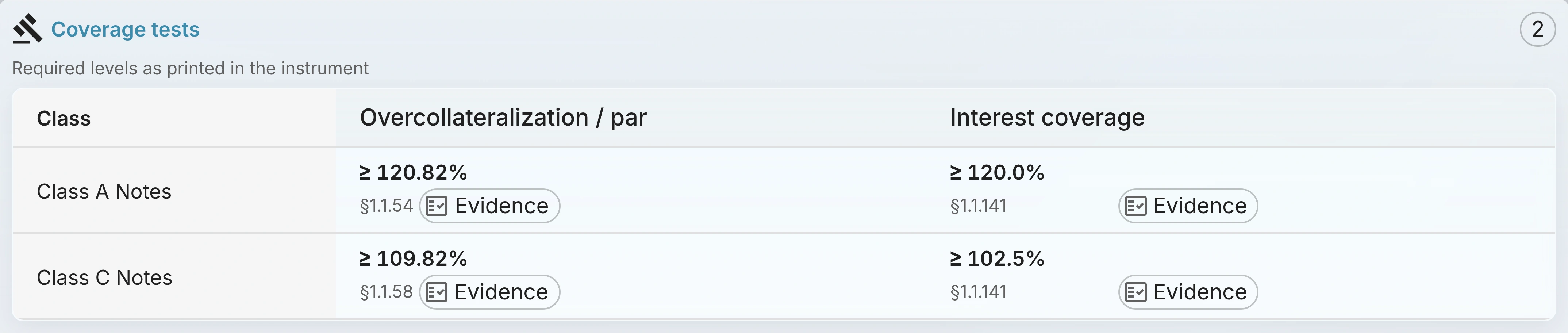
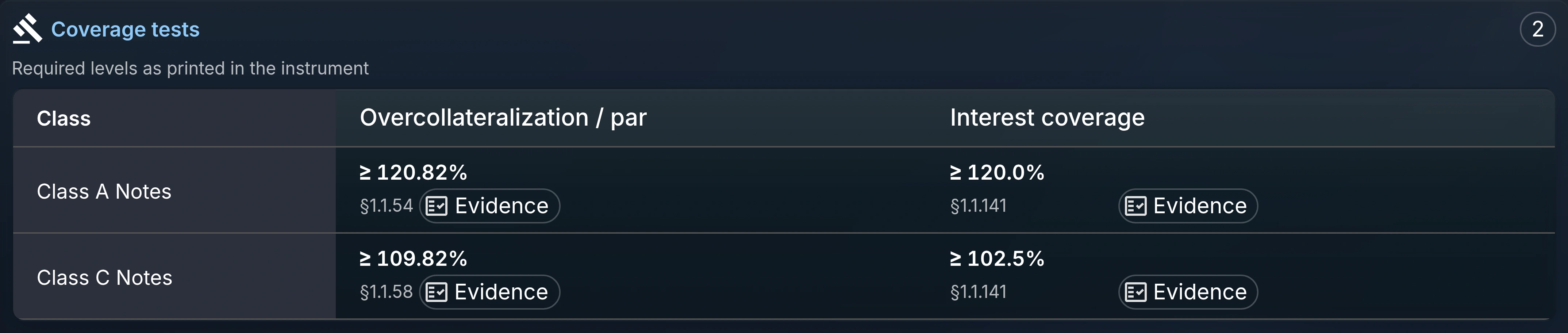
…to the payment of principal of the Class A Notes if the Class A Par Coverage Test is not satisfied on the related Determination Date…
- Indentures & Amendments
- Offering Documents
- Trustee Reports
- Public Filings
- Other Relevant Information
- Issuer & Manager
- Arranger & Counsel
- Trustee & Administrator
- Rating Agencies
- Investors
- AI Agents
Talk to your whole book, at clause precision.
Questions that once meant re-reading every indenture are answered across every deal you hold. Each answer opens the clause behind it.
- Which of my deals let collateral be sold after a default on a simple-majority vote?
- Whose events of default depart from their program's standard template, and how?
- Where does the same trustee, manager or law firm appear across my deals?
- Which coverage tests sit closest to their triggers this quarter?
Answers that never guess.
Every answer comes back in three parts: the deals that match, the deals that do not, and the deals that cannot be judged, with the reason. A gap in the documents is reported as a gap. It is never filled with a guess.
- MatchDeal AMajority of the Controlling Class may direct a sale5.5(a)
- No matchDeal BRequires a supermajority of each Class5.4
- Cannot be judgedDeal CThe sale provision refers to a schedule that is not in the record
Pick any date. See what the deal said that day.
Amendments, supplements and restatements are linked into one chain, so DealGraph knows which version of every term is in force and exactly what each amendment changed. Earlier readings are kept, not overwritten. Where two documents disagree, both readings stay on the record, each with its source.
- What changed, term by term: moved, added or removed.
- What the deal said on any date, and what was knowable then.
- Every issue dated twice: when the documents first showed it, and when someone noticed.
- Reinvestment Period end· was
15 July· now 15 October - Class B spread· unchanged
Every step of the waterfall, with its clause beside it.
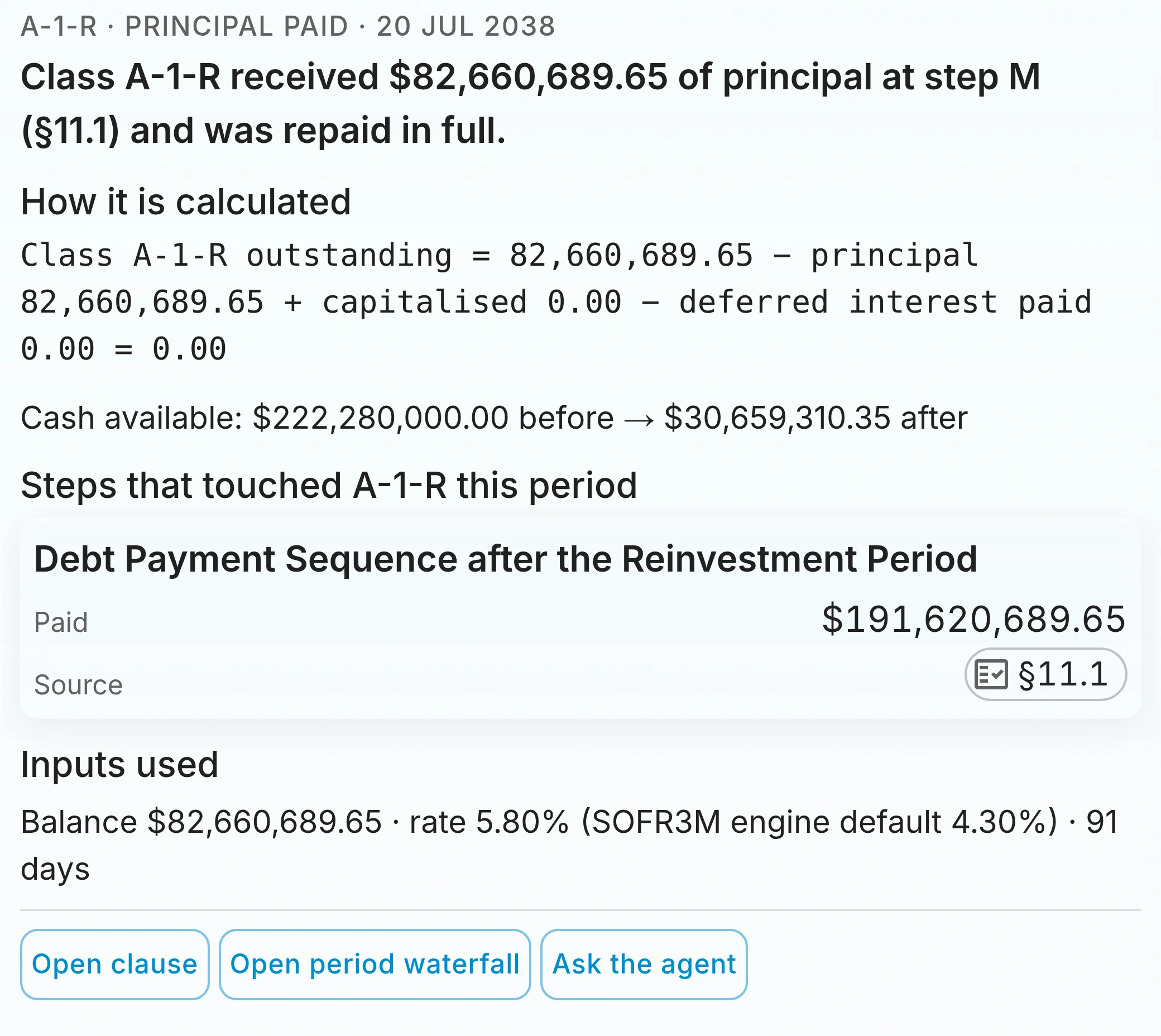
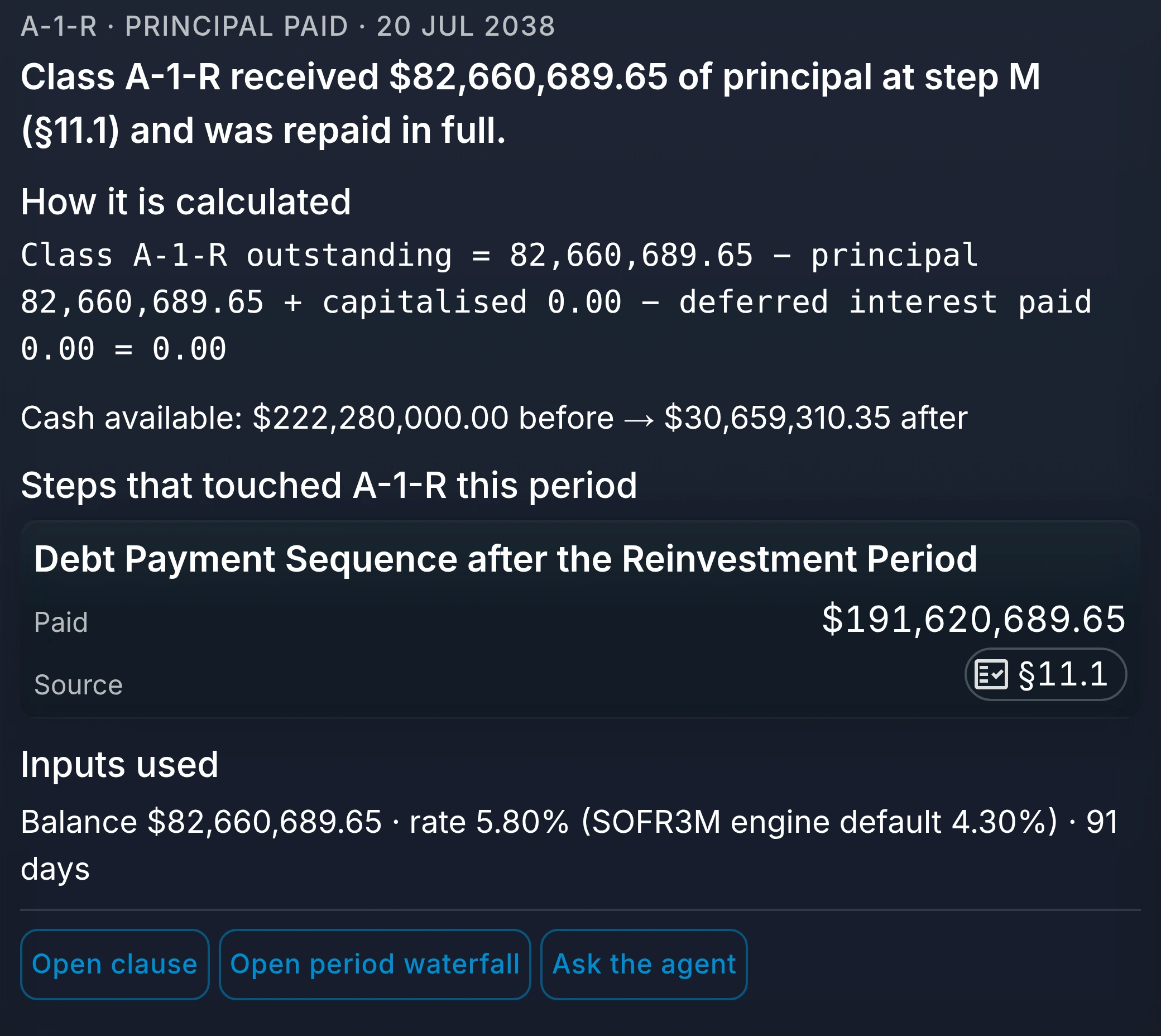
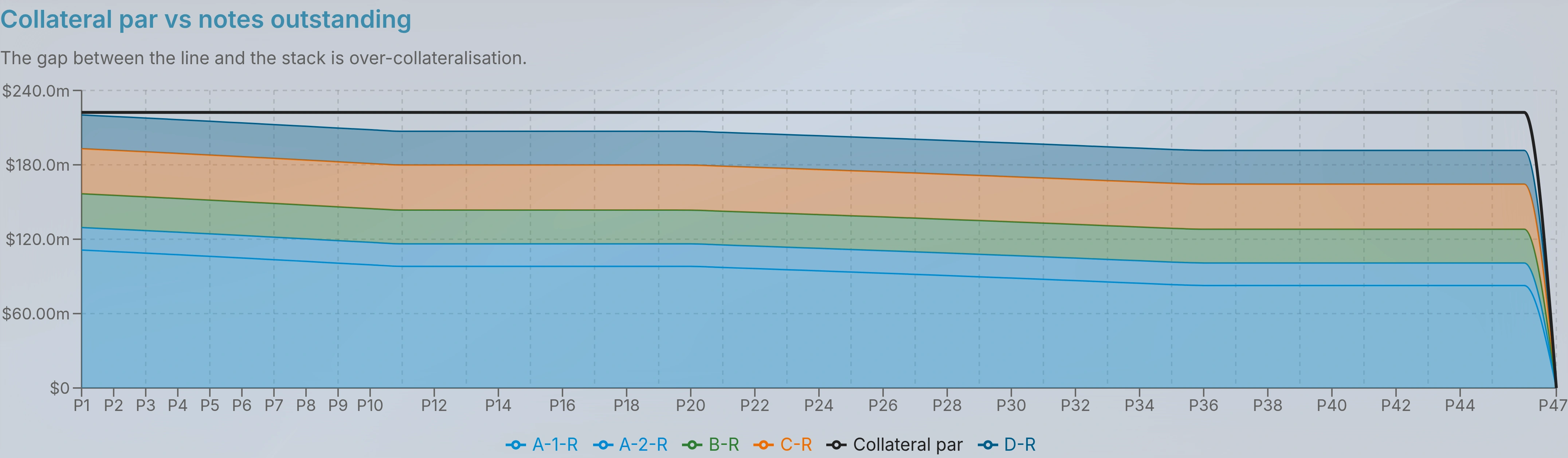
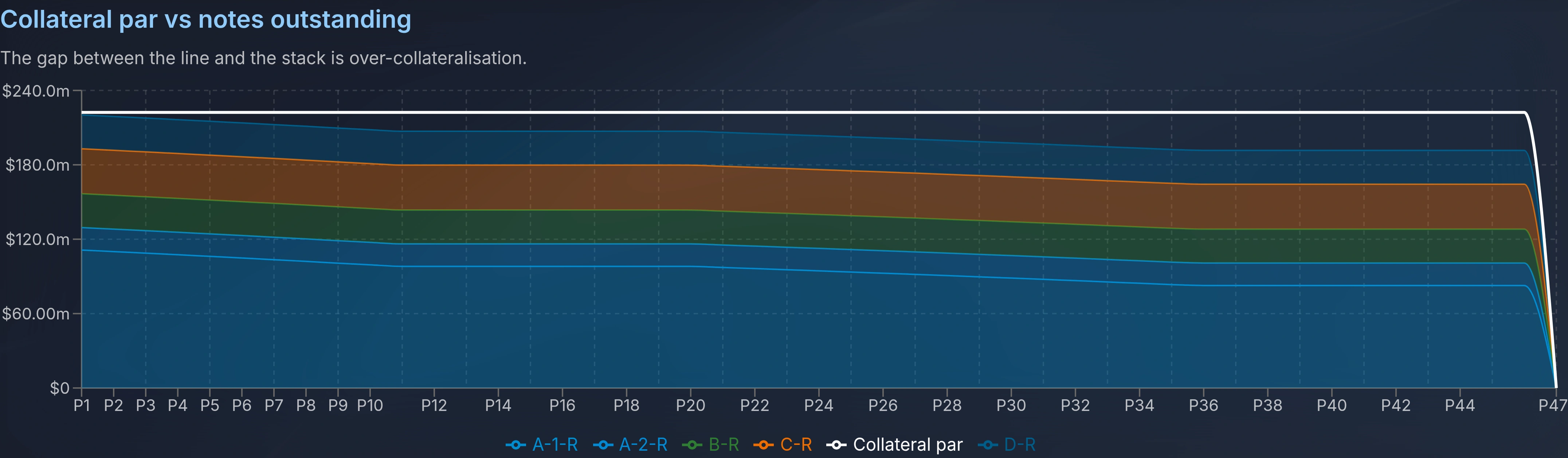
The cash-flow model is built from the deal's own priority of payments, not rebuilt by hand in a spreadsheet. Each step carries the clause it came from. Ask why a class received what it did in any period and the answer shows the formula, the cash available before and after, the tests applied and the sections that govern them.
- Scenarios with every assumption stated and comparable side by side.
- Returns, breakevens and sensitivities for each class and for equity.
- A workbook an analyst can open, check and take away.
- Coverage tests run inside the waterfall: when a test fails, the model diverts cash exactly as the priority of payments directs, and shows the step where it happened.
- Export to Excel with live formulas, so every figure can be re-derived cell by cell outside DealGraph.
- Upload a collateral tape and run the deal on your own loans. Every row the model cannot read is named, with its row number.
- Every projected figure set beside the figure the trustee printed, with the difference and a link to the report line.
- Replay a deal's past payment dates and see how closely the model reproduces each trustee report.
- (A)Taxes and fees 11.1(a)(i)(A)
- (B)Class A interest 11.1(a)(i)(B)
- (C)Class A principal if the Par Coverage Test is not satisfied 11.1(a)(i)(C)Diverted to cure the test
- (D)Class B interest 11.1(a)(i)(D)
- Class A interest = balance × rate × days / 360
- Cash available before and after
- Test applied: Passed
Each test names the section that defines it and the section that says what happens when it fails.
The conflicts a careful reader quotes but does not connect.
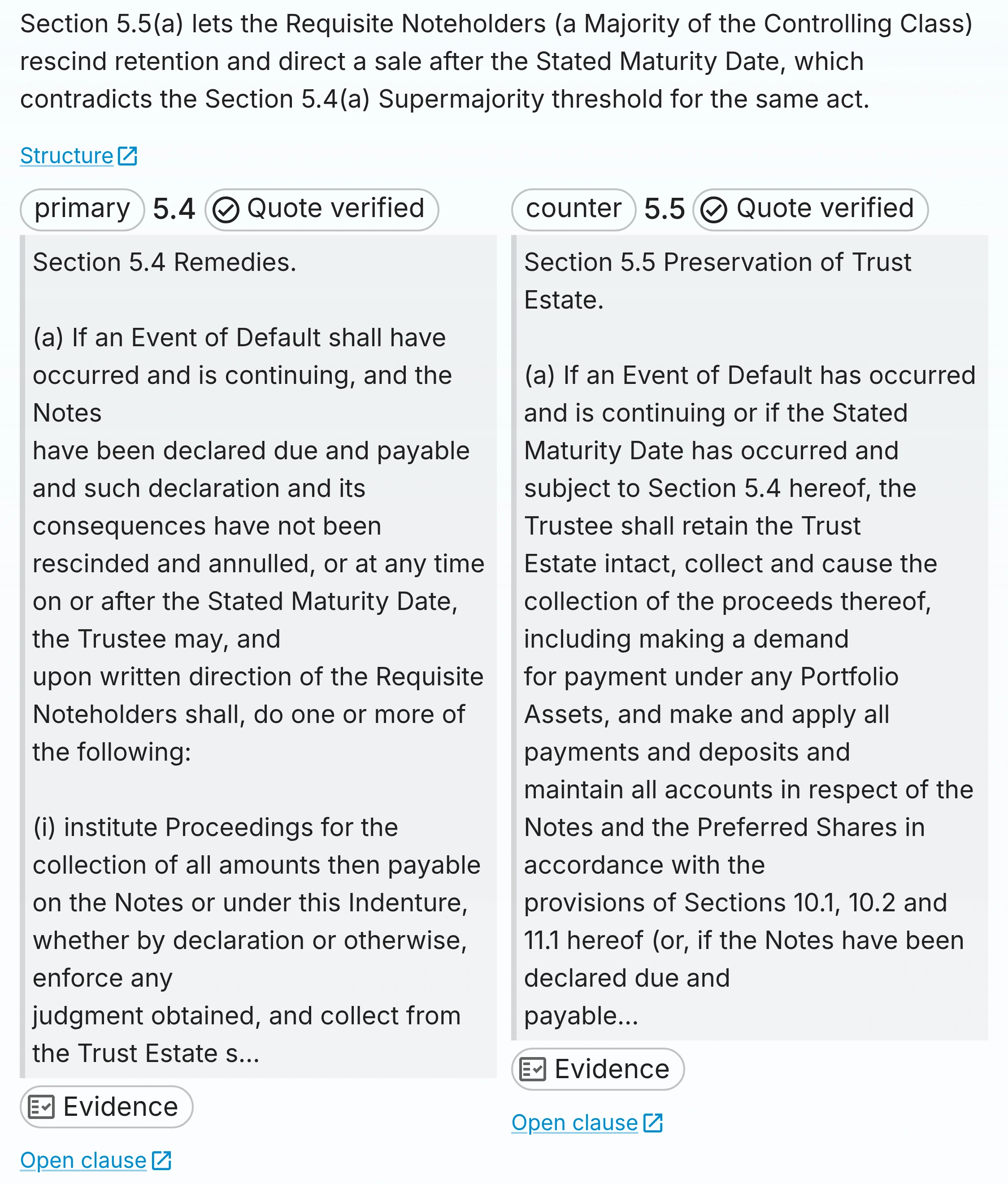
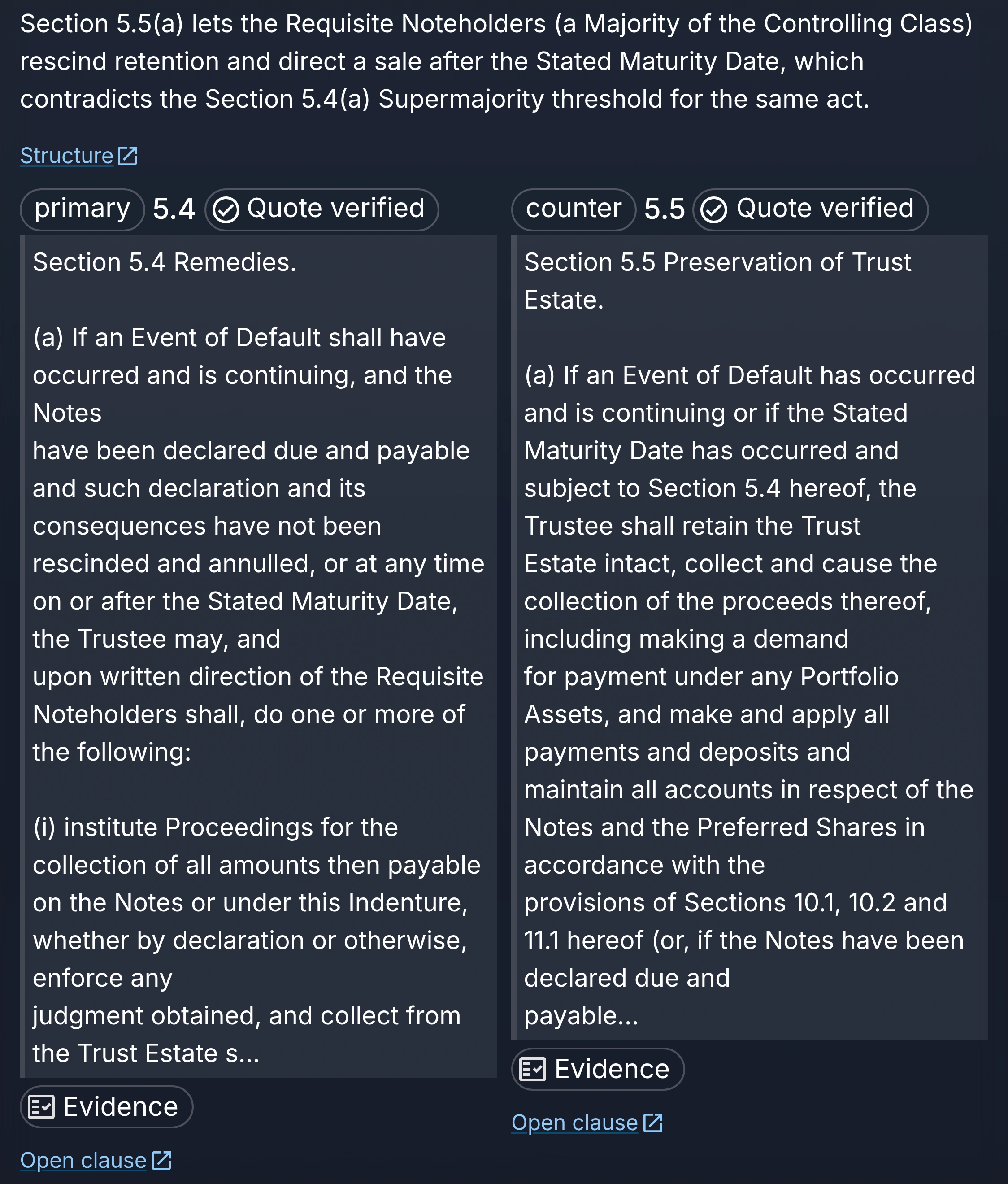
A definition in one article and a mechanic in another can each read correctly and still contradict each other. Because every clause is tied to the clauses it relies on, DealGraph checks a deal's documents against themselves and flags where they disagree, with both passages side by side. Each finding is labelled by how it was found, so counsel can weigh it.
You decide who sees what, and for how long.
Access is granted by party, by note class and by document, for a period you set. An investor sees its own class, its reports and its rights. A rating agency sees the structure and tests it is granted. Every view is logged and every download is stamped with its recipient.
- 01
Private by default
Your team only, until you decide otherwise.
- 02
Shared on your terms
Only the parties you pick, with the scope and duration you set.
- 03
On the record
Every grant, view and revocation logged. Access can end; the history stays.
Across the life of the transaction.
Close with fewer surprises.
Terms are mapped as they are drafted. Conflicts between provisions get caught before closing. A diligence question is answered once, with the clause cited.
Know where the deal stands.
Payment and notice dates come straight from the documents. Tests are tracked against their triggers. Holdings, cash and payments are reconciled, and each break is dated.
Prove what happened.
Every number has a source. Every change is recorded, and the audit log is sealed each hour with a published hash, so a rewrite of history is detectable. The full history of the deal sits in one place, not in inboxes.
From the first mandate to the final payment.
A deal is worked through mandate, warehouse, structuring, drafting, pricing and closing, then through reinvestment, amortization, call and redemption. DealGraph keeps the stage, the people and the work on the same record as the documents. A deal that is withdrawn stays on the record.
Start a deal in one step.
Name the deal and its type. DealGraph shows what it will create before it creates anything.
Stage gates.
A deal moves to its next stage when one person proposes the move and another decides it, with the evidence attached. A stage whose gate is not met refuses the move.
The reinvestment period ends.
When a deal's reinvestment period has passed, DealGraph proposes the move to amortization and leaves the decision to the collateral manager.
A view for each role.
Collateral managers, arrangers, counsel, trustees and others each open a saved timeline built for their work.
The deal is the project.
There is no board to set up and nothing to keep in step. The obligations in the documents become the work, and the work always opens on the clause behind it.
- Payment dates, notices and tests become tasks, recurring tasks and milestones, each assigned to a deal role.
- A task that needs proof is done when the proof is attached.
- When an amendment moves a date, the task it created is replaced and the reason is recorded.
- Every deal's dates and tasks on one timeline, across all the deals you hold.
From the first trade to the closing deal.
The warehouse is part of the deal record. Its terms are cited to the document, and every trade is checked against them on the day it is recorded.
- Eligibility, concentration, advance rate and margin triggers are checked on each trade.
- Test a trade before you record it.
- The position is reconciled with the lender's report, line by line.
- At closing the assets move to the new deal with the history intact.
One record, read differently by each party.
Issuer & Sponsor
Answer diligence once, for everyone.
Collateral Manager
Run tests and notices off the same terms.
Arranger
Structure and distribute from the record.
Legal Counsel
Check every term against its source.
Trustee & Administrator
Deliver reports to exactly those entitled.
Rating Agencies
See the structure and tests they are granted.
Investors
Their class, their reports and their rights, quoted.
Secondary Buyers
Time-bound access for diligence.
Your counterparties, on the deal.
DealGraph includes a CRM for the counterparties you work with. A counterparty profile links to its place on a deal, and what you record about a counterparty stays with your firm.
- A profile for each counterparty: its type, domicile, identifier and what it is eligible for, with who attested to it and when it expires.
- Import a list of counterparties from a file, with the full plan shown before anything is saved.
- Map a deal's party directory to your own records, and see who covers each party and when you last touched it.
- A workspace arranged for a collateral manager, an arranger or an investor.
Your AI assistant works from the same record.
Everything a person can do in DealGraph, an AI agent can do through governed tools, under that person's own permissions and the same evidence rules. An agent cannot see more than its user may, and every answer it gives carries its clause.
DealGraph connects to the assistant your firm already uses through the Model Context Protocol. The agent asks the record the same questions an analyst would, runs the same cash-flow scenarios, and returns the same cited answers. Every call it makes is logged against the person it acted for.
Structured finance runs on documents every party reads separately and no one can query.
DealGraph makes the deal itself the shared system: read once, connected to every other deal, and trusted by everyone who relies on it.
Your deals stay yours.
Each customer runs in its own isolated tenant. Inside it, access follows your organization: by team, by role, by deal, by note class and by document. Nothing is shared outside your organization until you grant it, and every grant has a scope and an end date.
Isolation
Separate tenants, with dedicated-instance options for firms that require them.
Identity
Single sign-on and automated provisioning from your own directory. Role-based access throughout.
Encryption
Sensitive fields encrypted individually, in addition to encryption in transit and at rest.
Audit
A tamper-evident log of who saw what, who changed what, and what every agent did on whose behalf, sealed each hour with a published hash.
See your own deal as a record.
Bring one indenture. We will show you its parties, waterfall, tests and conflicts, each tied to its clause.